
Electric vehicles and modern electronic systems are creating new challenges for sealing materials.
Higher power density, compact packaging, liquid cooling, outdoor operation and increasingly integrated electronic assemblies mean that a seal is no longer expected to simply keep water out.
It may need to resist coolant, maintain compression after thousands of thermal cycles, electrically isolate components, withstand vibration and continue sealing throughout years of operation.
This is one reason custom silicone seals and liquid silicone rubber (LSR) components are increasingly used in EV, energy storage, charging equipment, sensors and electronic devices.
However, choosing silicone is only the beginning.
Successful sealing depends on the correct material formulation, hardness, compression design, part geometry and manufacturing process.
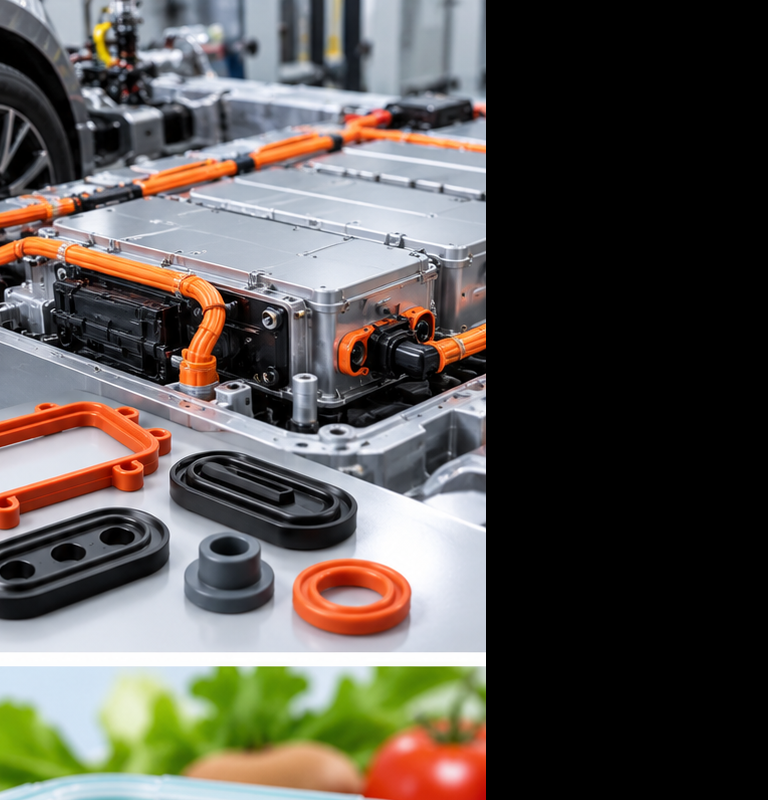
Why Are EV and Electronic Sealing Requirements Becoming More Demanding?
Traditional electronic products often operated in relatively stable environments.
Modern EV and high-power electronic systems can experience:
- Rapid temperature changes
- Continuous vibration
- Water and humidity
- Dust and fine particles
- Automotive coolants
- Oils and chemicals
- High-voltage electrical environments
- Long-term compression
- Outdoor weather exposure
At the same time, manufacturers are trying to make systems smaller and lighter.
This means sealing components must provide reliable performance in increasingly limited installation space.
Typical applications include:
- EV battery packs
- Battery management systems
- Inverters
- On-board chargers
- DC/DC converters
- Charging connectors
- Electronic control units
- Automotive sensors
- Liquid-cooling systems
- Outdoor electronics
- Industrial control equipment
- Energy storage systems
These applications are driving demand for engineered silicone seals rather than simple standard rubber gaskets.
Why Is Silicone Used for EV and Electronic Seals?
Silicone rubber offers a combination of properties that is difficult to achieve with many conventional elastomers.
Wide Operating Temperature Range
Temperature resistance is one of silicone’s most important advantages.
Depending on the formulation, silicone components can maintain useful flexibility across a wide temperature range.
This is particularly valuable in automotive electronics where a vehicle may experience freezing outdoor temperatures followed by significant heat generated by batteries, motors and power electronics.
The exact operating range must always be confirmed for the selected silicone grade.
Electrical Insulation
Silicone is widely used in electrical and electronic systems because suitable formulations provide good dielectric properties.
This makes silicone attractive for components located near:
- High-voltage connectors
- Battery modules
- Power electronics
- Sensors
- Charging systems
- Electrical terminals
The material can provide both environmental sealing and electrical isolation within the same component.
Compression Performance
A gasket must maintain sealing pressure after being compressed for long periods.
If the material permanently deforms, the contact pressure between the gasket and housing decreases.
This can eventually create leakage paths.
For this reason, compression set is an important specification when selecting silicone for long-term sealing applications.
Weather and Aging Resistance
Silicone generally provides good resistance to ozone, UV exposure and environmental aging.
This is useful for charging equipment, outdoor electronic housings and industrial devices exposed to changing environmental conditions.
Liquid Cooling Is Changing EV Seal Requirements
One particularly important development is the increasing use of liquid cooling.
Battery systems, inverters, charging equipment and other high-power electronic systems generate significant heat.
As power density increases, manufacturers increasingly rely on cooling systems to control operating temperature.
This creates additional sealing challenges.
A component may now need to provide:
Waterproofing + Coolant Resistance + Temperature Resistance + Electrical Insulation
rather than simply preventing rainwater from entering an enclosure.
Coolant Resistance: Not Every Silicone Performs the Same
This is an important point for product designers.
It is incorrect to assume that every silicone rubber formulation provides the same performance when exposed to automotive coolant.
Different coolant systems may contain:
- Water
- Ethylene glycol
- Propylene glycol
- Corrosion inhibitors
- Additives
- Other chemical components
Long-term exposure can affect elastomers differently.
Possible changes include:
- Swelling
- Hardness change
- Tensile strength loss
- Elongation change
- Compression-set deterioration
- Dimensional change
Therefore, coolant resistance should be evaluated using the actual silicone formulation and actual coolant used in the application.
New LSR Materials for EV Coolant Applications
Material suppliers have been developing LSR grades specifically for emerging EV applications.
One development in this area is liquid silicone rubber designed to provide improved resistance to automotive coolant while retaining the processing advantages of LSR injection molding.
This reflects a broader trend in the silicone industry.
Instead of using one general-purpose silicone material for every application, manufacturers are increasingly selecting formulations optimized for specific requirements such as:
- Coolant resistance
- Oil resistance
- Low compression set
- Flame resistance
- High tear strength
- Electrical performance
- Adhesion to thermoplastics
- High-temperature operation
For an EV project, material selection should therefore begin with the actual operating environment rather than simply specifying “silicone rubber.”
HCR vs LSR for Custom Silicone Seals
Both high-consistency rubber (HCR) and liquid silicone rubber (LSR) can be used for sealing components.
The best process depends on the geometry, production volume, tolerances and functional requirements.
HCR Silicone
HCR can be suitable for:
- Compression-molded gaskets
- Larger seals
- Lower-volume production
- Relatively simple geometries
- Industrial sealing components
LSR
LSR injection molding is particularly attractive for:
- Small precision seals
- High-volume production
- Thin sealing structures
- Complex geometries
- Automated manufacturing
- Multi-cavity tooling
- Insert molding
- Silicone overmolding
LSR’s low viscosity before curing allows it to reproduce very small mold features.
However, this also means mold precision and flash control become extremely important.
IP67 and IP68: What Do They Actually Mean?
Customers frequently ask for an “IP67 silicone seal” or “IP68 gasket.”
Technically, this description can be misleading.
IP67 and IP68 are protection ratings for the assembled enclosure or product — not certifications that automatically belong to a piece of silicone rubber.
The silicone gasket contributes to achieving the required protection level, but sealing performance also depends on:
- Housing geometry
- Gasket groove design
- Compression ratio
- Surface flatness
- Fastener location
- Fastening force
- Part tolerances
- Connector interfaces
- Assembly process
Therefore, selecting a good silicone material does not automatically guarantee IP67 or IP68 performance.
The complete assembly should be tested.
Designing Silicone Seals for IP Protection
Several design factors strongly influence sealing performance.
1. Compression Ratio
A gasket must be compressed enough to create continuous sealing pressure.
Too little compression may allow leakage.
Too much compression can overstress the silicone and increase long-term deformation.
The correct compression depends on the seal geometry, hardness and application.
2. Gasket Cross-Section
Common designs include:
- O-ring profiles
- Rectangular gaskets
- D-shaped seals
- Lip seals
- Custom molded sealing ribs
- Integrated overmolded seals
Custom profiles can often reduce material usage or improve sealing in limited installation space.
3. Groove Design
The gasket groove should control the position and compression of the seal.
Important factors include:
- Groove depth
- Groove width
- Corner radius
- Gasket volume
- Compression allowance
- Assembly direction
Poor groove design can cause gasket twisting, pinching or excessive compression.
4. Housing Flatness
Even a well-designed gasket cannot compensate indefinitely for an enclosure with excessive deformation or poor flatness.
This becomes particularly important for large battery housings and electronic enclosures.
5. Fastener Distribution
Screws and bolts create local clamping force.
If fasteners are spaced too far apart, the housing can deform between fastening points and reduce gasket pressure.
Seal design should therefore be considered together with the mechanical structure of the enclosure.
Custom Silicone Seals vs Standard O-Rings
Standard O-rings remain excellent solutions for many applications.
But EV and electronic products increasingly use complex housing geometries that cannot always be sealed efficiently with a standard circular O-ring.
Custom molded silicone seals can provide:
- Irregular sealing paths
- Integrated locating features
- Variable cross-sections
- Multiple sealing lips
- Cable or connector integration
- Anti-rotation features
- Assembly tabs
- Integrated mounting structures
These features can reduce assembly errors and simplify final production.
Silicone Overmolding for Electronic Components
Another growing approach is to mold silicone directly onto plastic or metal components.
Instead of manufacturing:
Plastic housing + separate gasket + manual gasket installation
the manufacturer may use:
Plastic housing + directly overmolded silicone seal
Potential advantages include:
- Fewer components
- Reduced assembly labor
- Lower risk of missing gaskets
- Better gasket positioning
- Potential for automated production
- More compact product design
Self-adhesive LSR can be particularly useful for this type of application when compatible substrates are used.
Typical EV Silicone Seal Applications
Battery Pack Seals
Battery systems require protection against moisture, dust and environmental contamination.
Depending on the design, silicone may be used for:
- Housing gaskets
- Connector seals
- Vent sealing components
- Cable seals
- Thermal-management system seals
Large battery enclosure gaskets require careful consideration of compression uniformity and housing deformation.
Inverter and Power Electronics Seals
Inverters and power-control systems generate heat while operating near high electrical loads.
Silicone seals may be used around:
- Covers
- Conectores
- Cooling channels
- Sensor interfaces
- Electrical terminals
Material selection should consider temperature, coolant exposure and electrical requirements.
Charging Connector Seals
EV charging systems may operate outdoors and experience repeated mechanical use.
Silicone components can provide:
- Waterproofing
- Dust protection
- Cable sealing
- Connector sealing
- Flexible insulation
UV and weather resistance can also become important for outdoor charging equipment.
Sensor Seals
Automotive sensors can be exposed to temperature cycling, vibration, water and chemicals.
Small precision LSR seals are well suited to automated production of high-volume sensor components.
What Should Engineers Specify When Requesting a Custom Silicone Seal?
Simply sending a drawing marked “silicone” is usually not enough.
For more accurate material selection and quotation, provide:
Material Requirements
- LSR or HCR if specified
- Shore A hardness
- Cor
- Required certifications
- Flame-retardant requirements
Operating Conditions
- Minimum temperature
- Maximum temperature
- Continuous or intermittent exposure
- Indoor or outdoor use
Chemical Exposure
- Coolant type
- Oil
- Cleaning chemicals
- Water
- Humidity
Sealing Requirements
- IP target
- Pressure
- Compression
- Leakage requirement
- Expected service life
Production Information
- 2D drawing
- 3D STEP file
- Prototype quantity
- Annual volume
- Assembly method
Providing this information early can significantly reduce material-selection and tooling-development risks.
Validation Testing for EV and Electronic Silicone Seals
Before mass production, sealing components may require a combination of material and assembly testing.
Depending on the application, testing can include:
- Compression-set testing
- Thermal cycling
- Coolant immersion
- Chemical aging
- Water immersion
- Pressure testing
- Leak testing
- IP testing
- Pull testing
- Vibration testing
- UV/weather aging
- Dimensional inspection
Testing conditions should reflect the actual final application whenever possible.
For example, coolant testing should ideally use the coolant chemistry, concentration, temperature and exposure duration expected in service.
Common Silicone Seal Development Problems
Several issues repeatedly appear during custom sealing projects.
Selecting Material Based Only on Hardness
Two silicone compounds with the same Shore A hardness can have very different compression-set, tear-strength and chemical-resistance properties.
Hardness alone is not a complete material specification.
Ignoring Tolerance Stack-Up
Housing tolerance + gasket tolerance + groove tolerance can significantly change actual compression.
Tolerance analysis should therefore be completed before tooling.
Assuming Silicone Automatically Means IP68
IP performance belongs to the complete assembly.
A silicone gasket can help achieve the target, but it cannot compensate for every enclosure-design problem.
Testing Coolant Resistance Too Late
If the seal will contact coolant, chemical compatibility should be evaluated during material selection — not after the production mold has already been completed.
Using a Standard Seal for a Non-Standard Housing
Sometimes modifying the gasket geometry is more economical than redesigning the entire housing.
Custom silicone molding allows the sealing structure to follow the actual enclosure geometry.
From Rubber Gasket to Engineered Sealing System
The role of silicone components in EV and electronics manufacturing is changing.
A seal is increasingly treated as part of the overall product engineering system rather than a low-cost rubber accessory.
Material formulation, enclosure design, compression, manufacturing tolerances and environmental exposure all interact.
For this reason, the best time to involve a silicone manufacturer is often before the final housing and mold design are frozen.
Early DFM evaluation can identify potential problems with:
- Seal compression
- Groove dimensions
- Parting lines
- Flash
- Undercuts
- Material compatibility
- Overmolding
- Assembly
- Mass-production feasibility
These changes are relatively inexpensive during CAD development but can become costly after tooling has been manufactured.
Developing a Custom Silicone Seal for an EV or Electronic Product?
MadeForSilicone supports custom silicone and LSR components for automotive, electronic and industrial applications, including:
- Custom silicone gaskets
- LSR seals
- Connector seals
- Waterproof electronic seals
- Silicone grommets
- Sensor seals
- Silicone-to-plastic overmolding
- Silicone-to-metal overmolding
- Custom complex silicone components
For a new project, send us:
- 2D drawing or 3D CAD/STEP file
- Inscrição
- Silicone hardness requirement
- Operating temperature
- Coolant or chemical exposure
- IP target
- Estimated annual quantity
- Prototype requirements
Our team can review the material, seal geometry, molding process and DFM requirements before production tooling.
FAQ
Is silicone suitable for EV battery seals?
Silicone can be suitable for battery housings, connectors, electronic modules and related sealing applications because of its temperature resistance, electrical insulation and environmental aging characteristics. The specific formulation should be selected according to the actual operating environment.
Can silicone rubber resist EV coolant?
Certain silicone formulations are designed to provide improved coolant resistance, but not all silicone compounds behave identically. Testing should use the actual coolant, concentration, temperature and expected exposure conditions.
What is the difference between an IP67 and IP68 silicone seal?
IP67 and IP68 are ratings applied to complete enclosures rather than the silicone seal itself. Gasket design, compression, enclosure tolerances, fasteners and assembly quality all affect whether the final product achieves the target rating.
Is LSR better than HCR for electronic seals?
LSR is particularly suitable for high-volume, precision and complex sealing components, while HCR can be economical for larger or simpler molded seals. The correct process depends on geometry, tolerances, production quantity and performance requirements.
Can silicone be molded directly onto a plastic electronic housing?
Yes. Silicone overmolding and self-adhesive LSR can be used with selected engineering plastics. The exact plastic resin and silicone formulation should be tested for adhesion compatibility.
What files are needed to quote a custom silicone seal?
A 3D STEP file and 2D drawing are ideal. You should also provide material requirements, hardness, operating temperature, chemical exposure, IP target, prototype quantity and estimated annual volume.